
 By Yuvrajsinh Vaghela
Contents
- Which PHP tools to include in my tech stack?
- Which PHP IDE is best for my project?
- Will the IDE support the PHP framework I use?
- Which PHP debugging and testing tools should I use?
- How do I monitor my PHP application’s performance?
If you are struggling with these questions, this blog is for you.
PHP is the most used programming language for backend web application development. According to W3Techs, PHP powers 71.7% of all websites with a known server-side language, including platforms built on WordPress, Laravel, and Magento. Therefore, it comes as no surprise that there are a lot of PHP development software and tools for PHP web development.
To simplify your task of selecting the right PHP developer software, we have compiled a list of the 10 best PHP development tools across IDEs, code editors, debugging, testing, performance monitoring, and dependency management.
Being a leading PHP development company, we regularly use these PHP tools in our web projects. Our team of 50+ developers relies on a combination of IDEs, code editors, debuggers, testing frameworks, and application monitoring tools to deliver 200+ successful projects.
This blog lists the best tools for your PHP development projects.
What Are PHP Development Tools?
PHP development tools are software applications that help developers write, test, debug, and optimize PHP code more efficiently. These tools range from code editors and IDEs (Integrated Development Environments) that provide intelligent code completion and syntax highlighting, to testing frameworks that verify application behavior, debugging extensions that identify runtime errors, and performance monitoring tools that track application health in production.
A modern PHP development workflow typically involves tools from several categories:
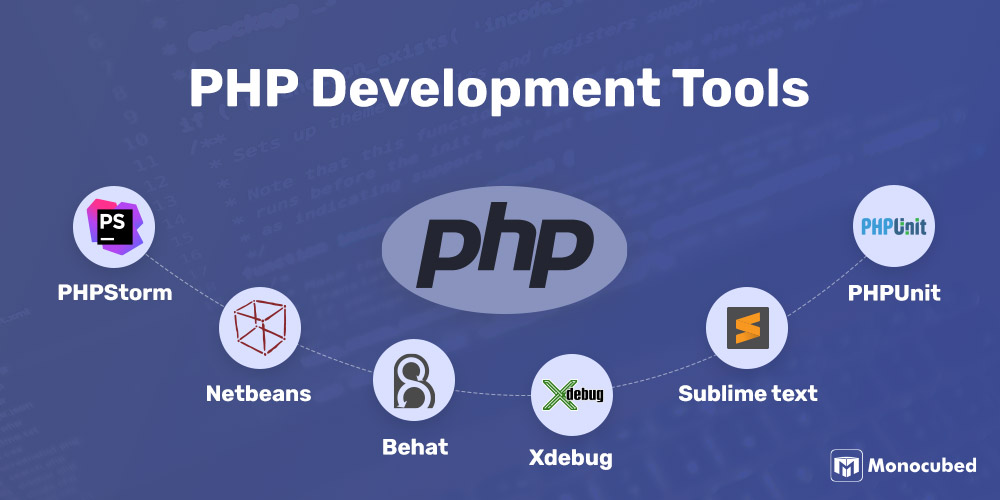
- IDEs and code editors for writing and navigating PHP code (PhpStorm, VS Code, Sublime Text)
- Dependency managers for installing and updating PHP packages (Composer)
- Debugging tools for finding and fixing errors (Xdebug)
- Testing frameworks for verifying code correctness (PHPUnit, Pest)
- Performance monitoring tools for tracking application speed and resource usage (Blackfire, New Relic)
The tools you choose depend on your project size, team experience, and whether you need a lightweight setup or a full enterprise development environment. Below, we review the best PHP development tools in each category.
Best PHP Development Tools for Web Developers
PHP is one of the oldest and most popular web scripting languages. It is open-source, flexible, reusable, scalable, and secure. But when you are working on complex projects, PHP can sometimes get a little tiring.
That is why we have developer-friendly PHP software and tools that take care of under-the-hood actions for you. You can focus on developing features and functionalities while these PHP web tools handle configuration, intelligent code completion, navigation, error checking, and performance monitoring.
Below, we cover 10 PHP tools across six categories: IDEs, code editors, debugging, testing frameworks, performance monitoring, and dependency management. Each tool is evaluated based on features, pricing, use cases, and our team’s hands-on experience.
The following table provides a quick comparison of all 10 PHP development tools covered in this guide.
| Tool | Category | Best For | Key Strength |
|---|---|---|---|
| PhpStorm | IDE | Enterprise PHP projects | Full-featured PHP IDE with framework support |
| Apache NetBeans | IDE | Budget-conscious teams | Open-source with cross-platform support |
| VS Code | Code Editor | Most PHP developers | Lightweight with massive extension ecosystem |
| Sublime Text | Code Editor | Speed-focused developers | Fastest editor with minimal resource usage |
| Xdebug | Debugger | All PHP debugging | Step debugging with IDE integration |
| PHPUnit | Testing | Unit testing | De-facto PHP testing standard |
| Pest | Testing | Modern PHP testing | Elegant syntax, built on PHPUnit |
| Blackfire | Performance Monitoring | PHP performance profiling | Code-level performance insights |
| New Relic | Performance Monitoring | Full-stack APM | Real-time PHP application monitoring |
| Composer | Dependency Management | All PHP projects | The standard PHP package manager |
Below, we break down each tool in detail with features, pros, cons, and our recommended use cases.
Want to Convert Your Web App Idea Into Reality?
Let’s validate your idea with experts and convert it into a highly performative web app. Schedule a free call with our consultants today.
1. PhpStorm – The Best PHP IDE
PhpStorm is the most popular PHP IDE among the PHP developer community. Although it is paid software, according to our PHP developers, it is worth every penny.
It is the preferred IDE for PHP development projects for several reasons. Firstly, it offers all the regular features of a PHP IDE like code completion, code refactoring and formatting, and live error-resolving.
PhpStorm is extremely efficient and easy to use. It simplifies many time-consuming tasks such as debugging, generating functions, and static code analysis. As a result, your productivity and efficiency will increase with this IDE as a PHP developer.
It automatically completes code for you using basic and type-matching completion. PhpStorm also uses intention actions to keep an eye on your code, detect potential errors, and suggest optimization techniques. The IDE also inspects your database and makes sure it is in sync with your PHP code.
Built on top of the IntelliJ IDEA platform, PhpStorm supports all versions of PHP. It also supports the top PHP frameworks of today like Laravel, Symfony, CakePHP, CodeIgniter, and Zend Framework. It seamlessly integrates with databases, Docker, version control systems, and other web development tools.
In addition, you can work with other languages such as HTML and CSS and web frameworks like Node.js for frontend development services.
We have used PhpStorm at Monocubed. From our experience, there are only 3 downsides/drawbacks:
- Large Size – It can be monolithic for smaller web projects (around 2GB in size).
- Paid Software – PhpStorm is a paid software costing around $234.82 per user for an organization. There is a 30-day trial period, and unlimited free access is available to students.
- Learning Curve – PhpStorm is bulky and comes with a lot of features. There is a steep learning curve if you are inexperienced with using IDEs.
When to use PhpStorm
We recommend using PhpStorm in all your PHP projects, no matter how complex.
- PhpStorm is an enterprise-grade IDE, best suited for large-scale PHP projects with large development teams.
- When you have a long-term project and want to experiment and play around, the IDE provides many out-of-the-box features for experienced PHP developers.
- If cost is not a factor for you, PhpStorm is the best IDE for PHP development.
2. Apache NetBeans – The Best Free PHP IDE
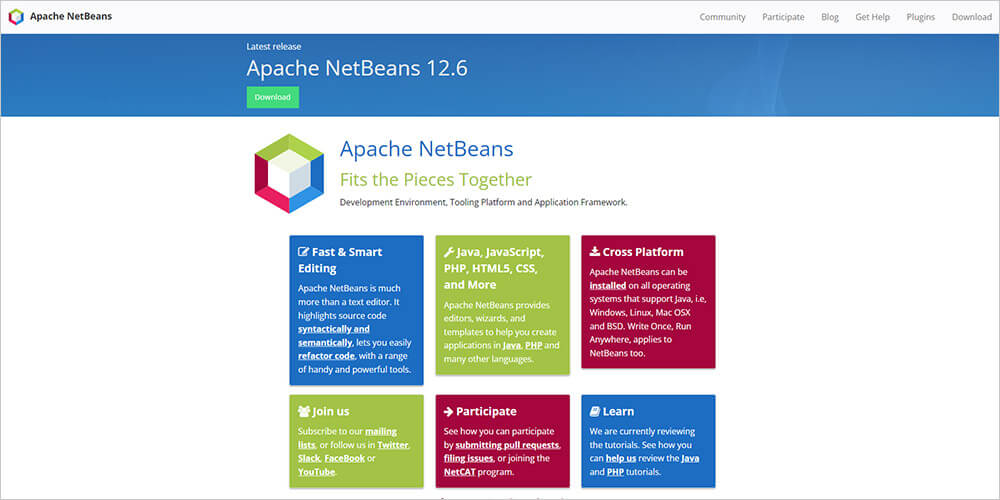
Not every developer or organization needs a paid PHP IDE. If you are working at a startup or on personal projects, a free PHP development environment can deliver everything you need without the extra cost.
For such cases, there is NetBeans, the best free PHP IDE. NetBeans provides most of the functionalities of PhpStorm, and it is completely free and open-source to use.
This PHP development platform provides a good developer experience with syntax highlighting, code completion, automatically inserting matching pairs for braces and brackets, code folding, and intelligent code suggestions.
The open-source integrated development environment also helps with code refactoring and code inspections.
Over the years, the development team has improved the platform into a lightweight, performative IDE supporting popular PHP frameworks. In fact, NetBeans is the best IDE for CodeIgniter development.
It also provides a development environment for other web languages such as JavaScript, C++, HTML5, and more. Another exceptional feature of NetBeans IDE is the cross-platform support for Windows, Linux, macOS, and Solaris. You can build multi-platform apps in no time with this PHP IDE.
When to use Apache NetBeans
We recommend using this open-source PHP development tool when:
- You are working on large projects involving PHP and other web languages.
- You are developing cross-platform web applications.
- You require a free, open-source PHP IDE with active community support.
3. Visual Studio Code – The Most Popular PHP Code Editor
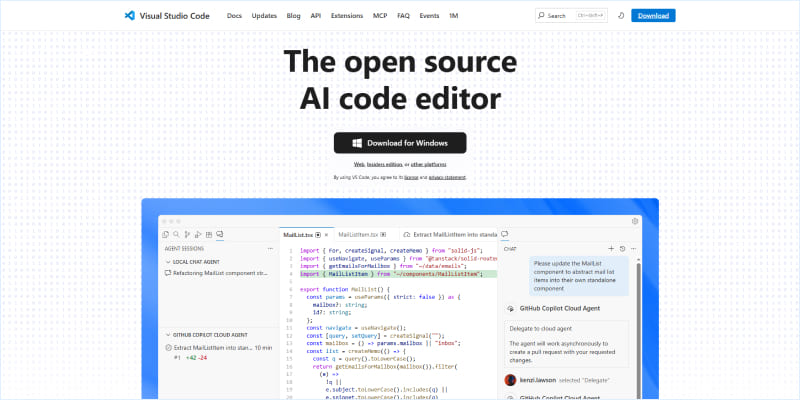
Visual Studio Code (VS Code) has become the most popular code editor among PHP developers. It is free, open-source, and developed by Microsoft. While it is not a full IDE out of the box, the extension marketplace transforms VS Code into a powerful PHP development environment.
The key PHP extensions that make VS Code competitive with dedicated PHP IDEs include:
- PHP Intelephense – Provides intelligent code completion, go-to definition, find references, and workspace-wide symbol search
- PHP Debug (Xdebug adapter) – Integrates Xdebug step debugging directly into VS Code
- PHP CS Fixer – Automatically formats your code to follow PSR-12 or custom coding standards
- PHPStan Extension – Real-time static analysis feedback as you code
VS Code starts up in seconds and uses significantly less memory than PhpStorm. It supports remote development through SSH, Docker containers, and GitHub Codespaces, making it suitable for teams using modern development workflows.
The built-in terminal, Git integration, and full-stack development support (JavaScript, TypeScript, Python, Go) mean you can work across your entire tech stack without switching editors.
When to use VS Code for PHP
- When you want a free, lightweight PHP editor with IDE-like features through extensions.
- When you work across multiple languages and need a single editor for frontend and backend development.
- When you need remote development support (SSH, containers, Codespaces).
4. Sublime Text – The Fastest PHP Code Editor
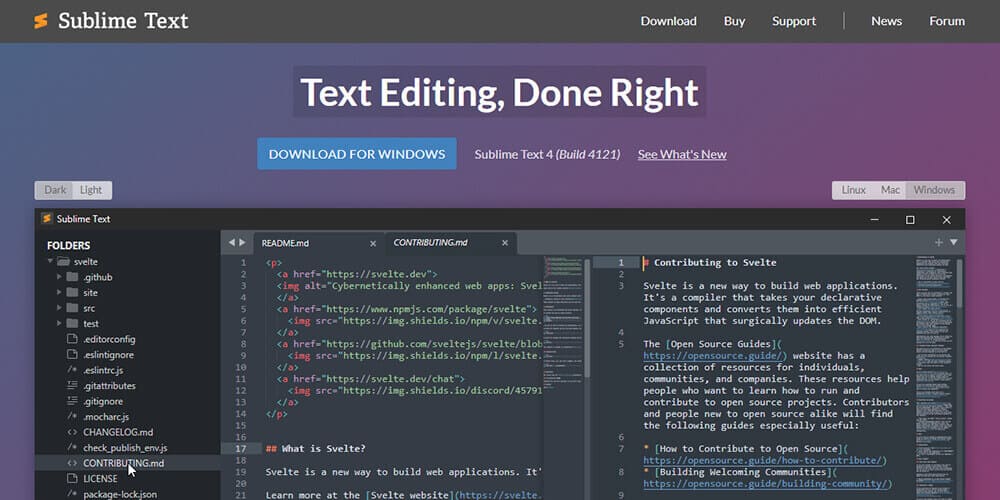
Not every project requires an IDE. Many personal projects or simple websites do not require the monolithic structure of a full PHP IDE.
For speed-focused projects, a code editor like Sublime Text is perfect. It is extremely lightweight and fast, launching in under a second even on older hardware.
It packs the most important features like code navigation, code completion, and code formatting. But to ensure higher performance, other complex functionalities are offered as plugins.
Sublime Text 4 includes features that make it a strong PHP code editor:
- GPU Rendering for a smoother UI experience
- Better code navigation with multi-tab selection, goto anything, goto definition, and auto-completion
- License covers all updates during the license period (no longer tied to a major version)
- Built-in TypeScript, JSX, and TSX support for frontend development
When to use Sublime Text
- If you are just starting with PHP, Sublime Text is a good code editor to start with, as it will take care of a lot of under-the-hood processes.
- When you are working on simple web apps and websites that do not require extensive debugging.
- If you require something lightweight and powerful with minimal resource usage.
Need Expert PHP Developers for Your Next Project?
We have delivered 200+ custom PHP projects for startups and enterprises with 98% client satisfaction. Let’s discuss yours.
Best PHP Debugging Tools
5. Xdebug – The Best PHP Debugging Extension
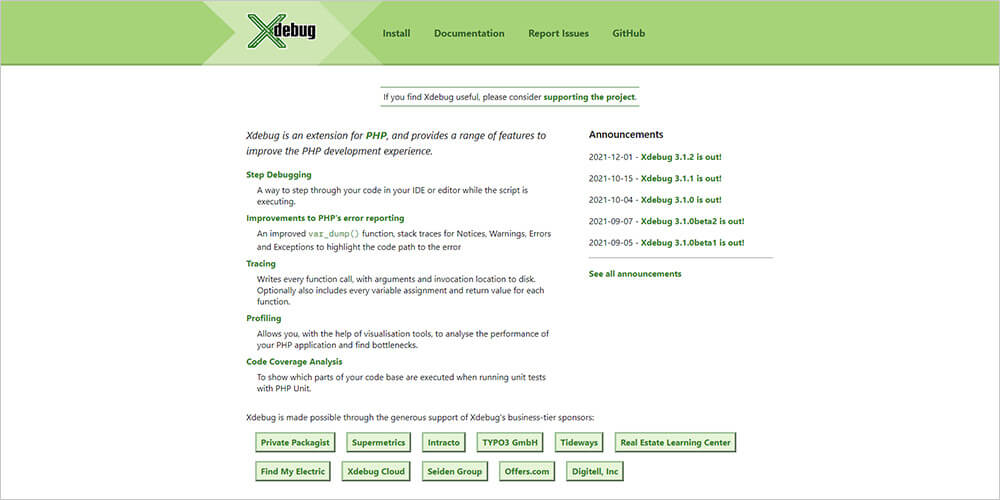
Debugging is an important part of the web application development lifecycle. It is important to debug your code to ensure a bug-free, smooth user experience.
If you are developing a PHP web application, Xdebug is the industry-standard debugging extension.
Most PHP IDEs and code editors support the Xdebug extension, including PhpStorm, NetBeans, VS Code, Zend Studio, and Eclipse PDT.
Xdebug follows the step debugging process. Therefore, you can go through the code step-by-step and see exactly where the error is happening. It is one of the easiest ways to troubleshoot web apps, as you can pause the app anytime and see where the code is going wrong.
Beyond step debugging, Xdebug provides function traces, code coverage analysis for PHPUnit, and an improved var_dump() output that makes inspecting complex data structures significantly easier.
According to the PHP developer community, the initial setting up of Xdebug with an IDE can be tricky. However, most modern IDEs now include Xdebug setup wizards that simplify the configuration process.
Once configured, Xdebug is an indispensable PHP development tool that you can enable or disable as needed.
When to use Xdebug
- When you want clean, bug-free code in any PHP project.
- When dealing with large datasets or complex application logic. Xdebug will help you identify errors easily.
- When you need code coverage reports for your PHPUnit tests.
Best PHP Testing Tools
6. PHPUnit – The Best PHP Unit Testing Framework
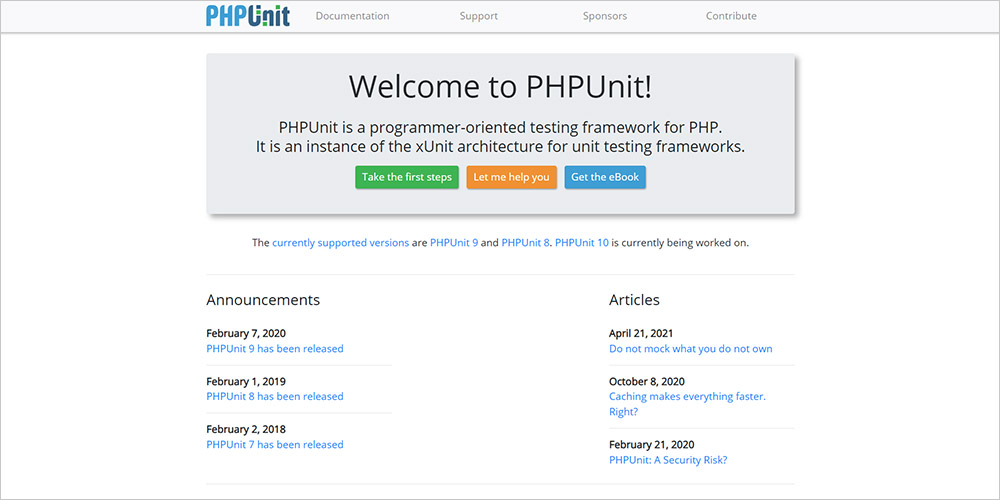
PHPUnit is the de-facto testing framework for PHP web developers. Developers can write unit tests for PHP web apps simply and efficiently.
Derived from JUnit (Java’s testing framework), PHPUnit has been the standard PHP testing tool since 2001.
In unit testing, the whole application code is divided into smaller groups or units. Then, each unit is tested individually with different test cases. Unit testing helps ensure that each part of the web application is working correctly.
PHPUnit is supported by all popular PHP web frameworks and IDEs, including Laravel, Symfony, CakePHP, and PhpStorm.
It is actively maintained by the development team. It provides stability, efficiency and works with every codebase. PHPUnit supports data providers, mocking, and assertions for flexible test writing.
PHPUnit supports integration testing and functional testing too. By adding extensions like Selenium, you can also perform acceptance testing on your web application.
When to use PHPUnit
PHPUnit is the standard testing tool for writing and performing unit tests on PHP web applications.
- If you are going with the unit testing methodology, PHPUnit is the simplest, most efficient framework.
- If you want to test the consistency and scalability of your websites and web applications.
- When you need code coverage reporting integrated with your CI/CD pipeline.
7. Pest – The Modern PHP Testing Framework
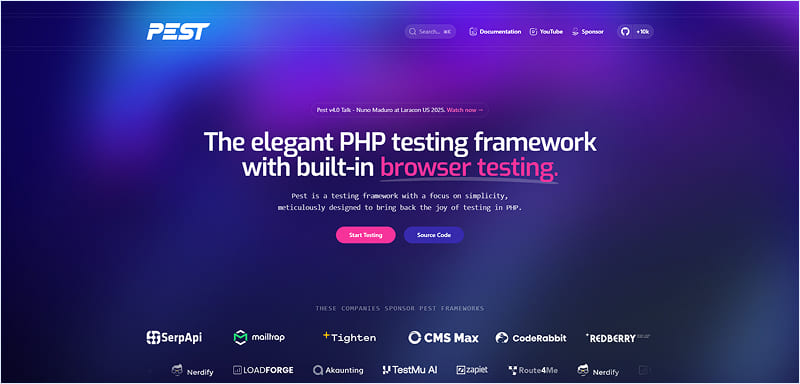
Pest is a modern PHP testing framework built on top of PHPUnit. Created by Nuno Maduro (a Laravel core team member), Pest brings an elegant, expressive syntax to PHP testing that reduces boilerplate code significantly.
Where PHPUnit requires class definitions and method annotations, Pest uses a functional syntax inspired by JavaScript testing frameworks like Jest:
- Concise syntax – Write tests in 50% fewer lines compared to raw PHPUnit
- Built-in expectations API – Readable assertion chains like expect($value)->toBe(true)
- Architecture testing – Enforce coding standards and dependency rules automatically
- Parallel test execution – Run tests across multiple processes for faster feedback
- Full PHPUnit compatibility – All PHPUnit plugins and assertions work with Pest
Pest has been adopted by the Laravel ecosystem and is now the default testing framework in new Laravel projects. It works with any PHP project, not just Laravel.
When to use Pest
- When you want a cleaner, more readable testing syntax than raw PHPUnit.
- When you are starting a new Laravel project (Pest is now the default).
- When you want architecture testing to enforce code quality rules automatically.
Want a Custom PHP Web Application Built Right?
Monocubed builds PHP applications using Laravel, Symfony, and CodeIgniter with full testing, debugging, and performance monitoring built in.
Best PHP Performance Monitoring Tools
Writing clean PHP code is only half the battle. Monitoring how your PHP application performs in production is equally important. PHP performance monitoring tools help you identify slow database queries, memory leaks, and bottleneck functions before they affect your users.
PHP application monitoring tools fall into two categories: profilers (which analyze code execution during development) and Application Performance Monitoring (APM) tools (which track performance in production environments).
8. Blackfire – The Best PHP Performance Profiler
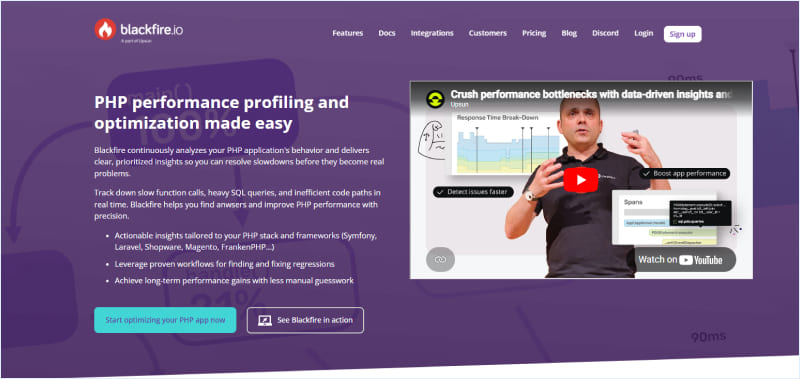
Blackfire (by Platform.sh) is a PHP performance monitoring tool purpose-built for profiling PHP applications. Unlike generic APM tools, Blackfire provides code-level performance insights that show exactly which functions, queries, and HTTP calls consume the most time and memory.
Key features of Blackfire as a PHP application performance monitoring tool:
- Code-level profiling – See execution time and memory usage for every function call
- Automated performance testing – Define performance budgets and run them in CI/CD
- Timeline view – Visual waterfall chart showing the full request lifecycle
- PHP framework support – Native integration with Laravel, Symfony, Magento, and WordPress
- Recommendations engine – Actionable suggestions for fixing performance bottlenecks
Blackfire’s free tier includes on-demand profiling for development. Paid plans (starting at $27.50/month) add continuous monitoring, alerting, and team collaboration features.
When to use Blackfire
- When you need to identify and fix specific slow functions in your PHP code.
- When you want automated PHP performance testing integrated into your deployment pipeline.
- When optimizing Laravel, Symfony, or Magento applications for speed.
9. New Relic – The Best Full-Stack PHP Application Monitoring Tool
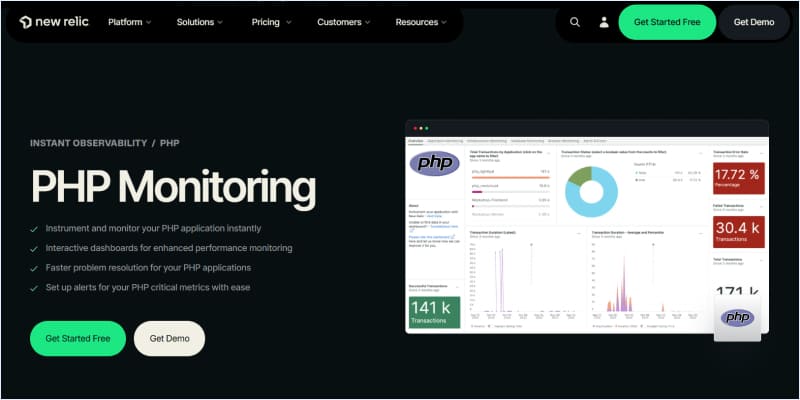
New Relic is a comprehensive Application Performance Monitoring (APM) platform that provides real-time PHP performance monitoring across your entire application stack. It tracks server response times, error rates, throughput, and transaction traces for PHP applications running in production.
What makes New Relic a top PHP application monitoring tool:
- Real-time dashboards – Monitor PHP application health with customizable dashboards
- Distributed tracing – Track requests across microservices, databases, and external APIs
- Error tracking – Automatic error detection with stack traces and contextual data
- PHP server monitoring – Track CPU, memory, and disk usage alongside application metrics
- Alerting – Configure alerts for response time degradation, error spikes, or resource limits
New Relic’s free tier includes 100 GB of data ingest per month, which is sufficient for monitoring small to medium PHP applications. For larger deployments, paid plans provide additional data capacity and advanced features.
When to use New Relic
- When you need production-level PHP application monitoring with real-time alerts.
- When your PHP application uses microservices or communicates with external services.
- When you need to track PHP server monitoring metrics alongside application performance.
Best PHP Dependency Management Tool
10. Composer – The Standard PHP Package Manager
Composer is the dependency manager for PHP. It allows you to declare the libraries your project depends on and manages (installs, updates, and autoloads) them for you. If you have worked with npm for JavaScript or pip for Python, Composer serves the same purpose for PHP.
Composer is not optional in modern PHP development. Virtually every PHP framework (Laravel, Symfony, CakePHP), testing tool (PHPUnit, Pest), debugging extension (Xdebug), and code quality tool (PHPStan, Laravel Pint) in the PHP ecosystem is installed and managed through Composer.
Key capabilities of Composer as a PHP development tool:
- Dependency resolution – Automatically resolves and installs compatible versions of all required packages
- Autoloading – Generates PSR-4 autoload files so you never need manual require statements
- Packagist integration – Access to 400,000+ PHP packages through the default Packagist repository
- Lock file – composer.lock ensures every team member and deployment uses identical package versions
- Scripts – Define custom commands (test runners, build steps, code formatters) in composer.json
Composer is free, open-source, and runs on Windows, macOS, and Linux. It requires PHP 7.2.5 or higher and is typically the first tool installed in any new PHP development environment.
When to use Composer
- In every PHP project. Composer is the standard for managing dependencies in modern PHP development.
- When you need to install frameworks (Laravel, Symfony), testing tools (PHPUnit), or any third-party PHP package.
- When you want consistent dependency versions across development, staging, and production environments.
How to Choose the Right PHP Development Tools
Choosing the right PHP development software depends on your project size, team experience, and budget. Here is a practical framework for selecting tools from each category:
For solo developers and small projects
Start with VS Code (free), Composer for package management, Xdebug for debugging, and PHPUnit or Pest for testing. This combination covers all essential development needs at zero cost. Consider adding PHPStan for static analysis and Laravel Pint for code formatting as your project grows.
For teams and enterprise projects
PhpStorm provides the most comprehensive PHP IDE experience for teams. Pair it with Composer, PHPUnit for testing, Blackfire for performance profiling, and New Relic for production monitoring. Add PHPStan for static analysis and Behat for BDD-style functional testing if your team follows behavior-driven practices.
For Laravel developers
The Laravel ecosystem has standardized around specific PHP tools: Pest for testing, Laravel Pint for code formatting, and PhpStorm or VS Code with the Laravel extension pack. For performance monitoring, both Blackfire and New Relic have native Laravel integrations. PHP Debugbar is also popular in Laravel for quick in-browser debugging during development.
Not Sure Which PHP Tools Fit Your Project Requirements?
Monocubed’s consultants help you pick the right tech stack, tools, and architecture based on your project scope, team size, and budget.
Build Your PHP Project With Monocubed
Picking the right PHP development tools is just one part of building a successful web application. You also need a team that knows how to use them effectively across planning, development, testing, and deployment.
At Monocubed, we have been building custom PHP applications for over 6 years. Our team of 50+ developers works with the tools covered in this guide every day. We use PhpStorm and VS Code for development, PHPUnit and Pest for testing, Xdebug for debugging, and Blackfire and New Relic for performance monitoring. This is not a list we researched. These are the tools our developers rely on across 200+ projects delivered for startups, SMEs, and enterprise clients.
Whether you need a custom web application built with Laravel, a high-traffic eCommerce platform on PHP, or a dedicated PHP development team to scale your existing product, we bring hands-on experience with every framework and tool in the PHP ecosystem. Our 98% client satisfaction rate and ISO 9001 certification reflect the development standards we maintain on every project.
Ready to build your next PHP application with a team that already has the tools and experience in place? Schedule a free consultation with our PHP development team to discuss your project requirements, technology stack, and timeline.
Frequently Asked Questions
-
Can I use Eclipse with PHP?
Yes. Eclipse PDT (PHP Development Tools) is a free, open-source PHP development IDE that you can use for PHP projects. It comes with a built-in PHP debugger, compiler, and profiler alongside a code editor. Eclipse PDT works well for large PHP projects but can feel heavy for smaller work. For most developers, PhpStorm or VS Code are more productive choices in 2026. -
Which is the best code editor for PHP?
VS Code and Sublime Text are the two best PHP code editors. VS Code is free with a massive extension ecosystem that adds IDE-like features (Intelephense, Xdebug integration, PHPStan). Sublime Text is the faster option ($99 license) with a minimal footprint. For most PHP developers, VS Code offers the best balance of features and performance. -
What are the best PHP performance monitoring tools?
The best PHP performance monitoring tools are Blackfire (for code-level profiling) and New Relic (for production APM). Blackfire is ideal for identifying slow functions during development, while New Relic provides real-time monitoring, alerting, and distributed tracing for PHP applications in production. Both offer free tiers suitable for small to medium projects. -
What is the best IDE for PHP development?
PhpStorm is the best PHP IDE for professional development. It offers comprehensive framework support (Laravel, Symfony, CodeIgniter), built-in database tools, Docker integration, and intelligent code completion. For a free alternative, Apache NetBeans provides similar features without the cost. VS Code with the Intelephense extension is a lightweight middle ground between a full IDE and a basic code editor. -
Which PHP testing tools should I use?
For unit testing, PHPUnit is the industry standard. For a modern, cleaner syntax, use Pest (which is built on PHPUnit). For functional and behavior-driven testing, Behat is a popular choice. Most PHP development teams use PHPUnit or Pest for unit tests and pair them with Xdebug for debugging to create a complete PHP testing workflow. -
Is VS Code good for PHP development?
Yes. VS Code is one of the most popular editors for PHP development in 2026. While it is not a PHP IDE out of the box, extensions like Intelephense (code intelligence), PHP Debug (Xdebug integration), and PHPStan transform it into a fully capable PHP development environment. VS Code is free, lightweight, and supports remote development through SSH, containers, and GitHub Codespaces. -
What PHP development tools do professional developers use?
Professional PHP developers typically use a combination of tools from different categories. Composer is the foundation for managing dependencies in every project. For coding, PhpStorm or VS Code are the most popular choices. Xdebug is the standard for step debugging. PHPUnit (or Pest for modern projects) handles testing. For production applications, Blackfire or New Relic monitor PHP application performance. -
How do I monitor PHP application performance?
To monitor PHP application performance, use a combination of profiling and APM tools. During development, use Blackfire or Xdebug to profile individual requests, identify slow functions, and optimize database queries. In production, deploy an APM tool like New Relic or Datadog to track response times, error rates, and server resources in real-time. -
What tools help optimize PHP performance?
PHP performance optimization involves multiple tools working at different levels. For code-level profiling, Blackfire identifies slow functions and memory-heavy operations. For production monitoring, New Relic tracks response times and alerts on degradation. PHPStan catches inefficient patterns through static analysis before code is deployed. For runtime optimization, tools like OPcache (built into PHP) cache compiled bytecode, while Redis or Memcached reduce database load through application-level caching. -
Can I develop PHP applications without an IDE?
Yes. Many PHP developers use lightweight code editors like VS Code or Sublime Text instead of full IDEs like PhpStorm. A code editor paired with the right extensions (Intelephense for code intelligence, Xdebug for debugging, PHPStan for static analysis) provides an IDE-like experience with less memory usage and faster startup times. For beginners, VS Code with the PHP Intelephense extension is the most productive starting point.

 All our projects are secured by NDA